Abhijeet Shenoi, VP of Engineering at Bunkerhill Health, and George Hu, Machine Learning Engineer at Bunkerhill Health, presented their work on radiology foundation models during the recent UCSF Center for Intelligent Imaging (UCSF ci2) SRG Pillar Meeting. Their talk "Foundation Models in Radiology: Lessons and Learnings," drew on a long-standing research relationship between Bunkerhill and the University of California, San Francisco (UCSF) where a significant portion of the training data originated.
The case for a radiology foundation model with a supply-and-demand problem. Imaging volume is growing at an estimated 3-4% annually, while radiologist shortages are projected to worsen into the 2030s. The presenters noted that the $80 billion in venture funding that flowed to AI startups in 2025 is unlikely to close that gap because "the data is vastly different. If you look at a scan, it looks nothing like natural images that are out there on the internet."
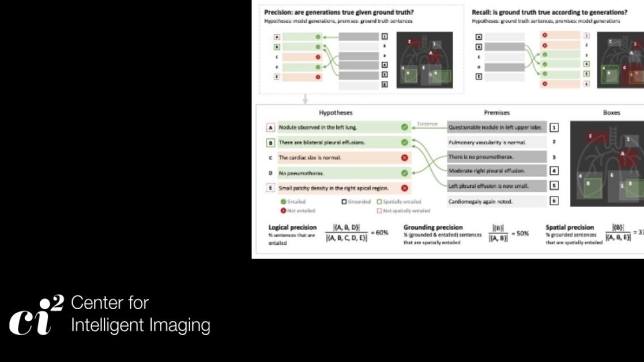
Bunkerhill's work focused on two tasks, radiology report generation (RRG) and visual question answering (VQA), applied to chest X-rays and body CTs. For chest X-ray, data scaling proved effective. Training on 1.27 million scan pairs pushed RadFact F1 to 0.786, surpassing the MAIRA-2 baseline, and scaling projections suggest that around 10 million chest X-rays could bring VQA error rates below 5%. CT proved significantly harder. Standard approaches used for natural images did not transfer, and the team found that anchoring model training on expert-provided disease structure, through auxiliary classification heads and disease summary prefixes, was essential to meaningful performance gains.
As Bunkerhill and ci2 continue their research partnership, next steps include making the model available to UCSF researchers and exploring how a radiology foundation model can be integrated into clinical workflows in ways that are practical, accurate, and built around how radiologists actually work.
To learn more about upcoming SRG Pillar meetings, visit the ci2 events page.