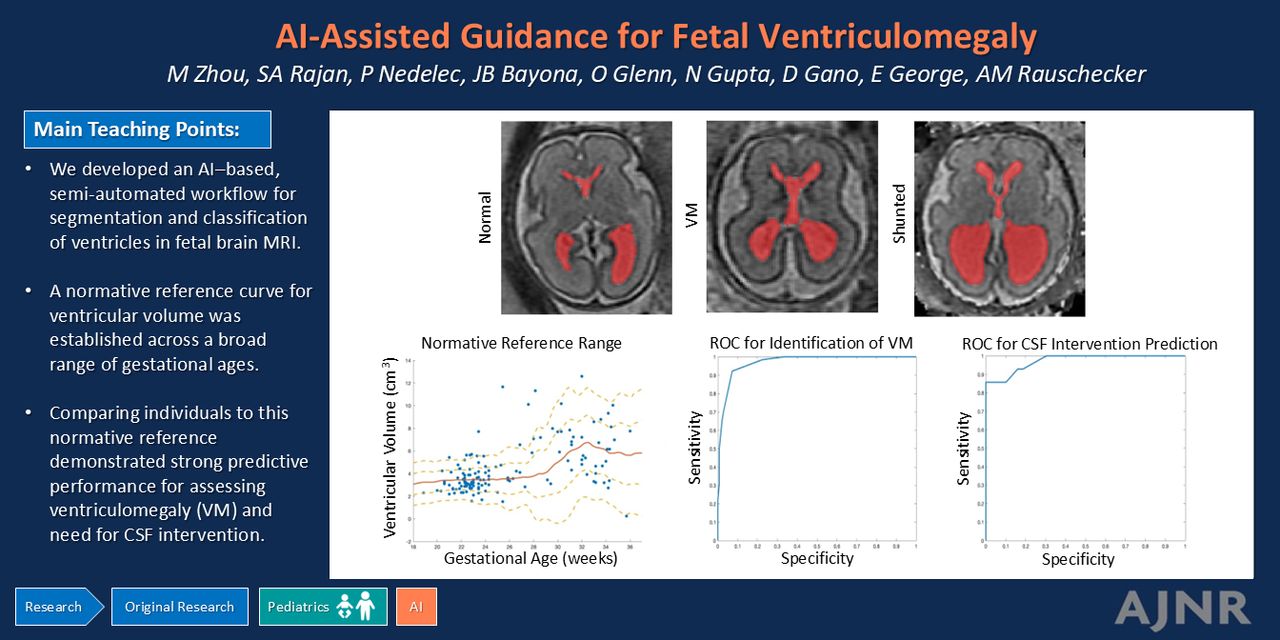
A team of researchers from the University of California, San Francisco's Department of Radiology and Biomedical Imaging and Center for Intelligent Imaging (ci2) developed a deep learning method for predicting the need for postnatal cerebrospinal fluid (CSF) intervention in fetuses diagnosed with ventriculomegaly.
The researchers, including ci2's Minerva Zhou, MD, Siddharthasiva Anbu Rajan, Pierre Nedelec, MS, Orit Glenn, MD, and Andreas Rauschecker, MD, PhD, along with UCSF colleagues Nalin Gupta, MD, PhD, Dawn Gano, MD, MAS, and Elizabeth George, MBBS, present their findings in “Prediction of CSF Intervention in Fetal Ventriculomegaly via Artificial Intelligence–Powered Normative Modeling,” published in the American Journal of Neuroradiology.
Fetal ventriculomegaly, or enlargement of the brain's fluid-filled ventricles, is common and usually benign. However, some cases progress to hydrocephalus, a more serious condition that may require surgical intervention after birth. Differentiating between the two has traditionally relied on subjective assessment and limited two-dimensional measurements.
Using an nnUNet trained on 100 fetal brain MRIs, the researchers segmented fetal ventricles with high accuracy (median Dice score: 0.96) and built a normative reference range of ventricular volumes spanning 18 to 36 weeks of gestational age. Applied to 64 fetal brains with ventriculomegaly, the model identified those requiring postnatal intervention with 86% sensitivity and 100% specificity (AUC: 0.97). Among fetuses who needed intervention, ventricular volume was significantly higher and subarachnoid volume significantly lower when normalized to intracranial volume.
The method offers an objective, reproducible approach to quantifying ventricular volumes in fetal brain MRI, with the potential to help predict which patients will need postnatal intervention.
Visit the UCSF ci2 blog to read more about research and news.